
If you’re on a UK Skilled Worker visa and thinking about starting a side business or taking on extra work, you’re not alone, and the answer isn’t a simple yes or no. The rules depend on what kind of work you’re doing, how many hours you’re putting in, and even when you first got your visa.
Use this checklist to find out whether the business or job you have in mind is actually permitted.
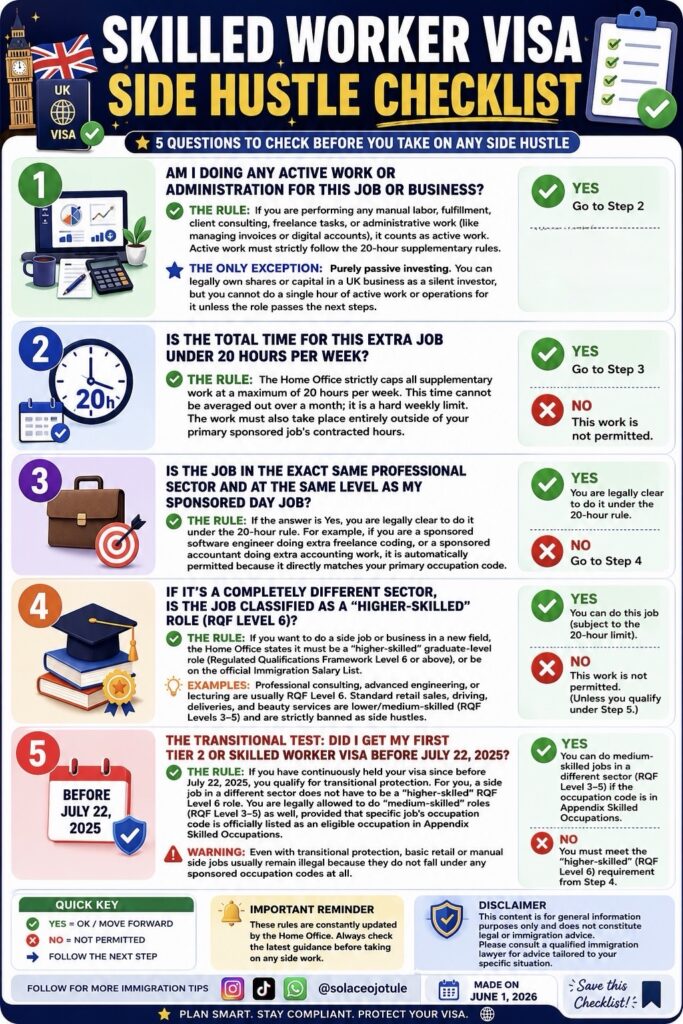
Step 1: Am I doing any active work or administration for this business?
The first thing to establish is whether your involvement counts as active work. This includes manual labour, client consulting, fulfilling orders, freelance tasks, or any administrative work, think managing invoices, running digital accounts, or handling customer queries. If you’re doing any of that, it counts as active work and must follow the rules in the steps below.
The one exception: Purely passive investing. You are legally allowed to own shares or capital in a UK business as a silent investor. But the moment you do a single hour of active work or operations for that business, you fall back under these rules.
Step 2: Is the total time under 20 hours per week?
The Home Office caps all supplementary work at a hard maximum of 20 hours per week. This is not an average, you cannot work 30 hours one week and 10 the next and call it even. It is a strict weekly limit, and the work must take place entirely outside your primary sponsored job’s contracted hours.
Step 3: Is the work in the exact same sector and at the same level as my sponsored job?
If yes, you’re in the clear. The Home Office automatically permits supplementary work that directly matches your primary occupation code, as long as you stay within the 20-hour weekly limit. A sponsored software engineer doing freelance coding, or a sponsored accountant taking on extra bookkeeping clients, both are permitted without any further hurdles.
If the answer is no and the work is in a completely different field, move to Step 4.
Step 4: Is the role classified as “Higher-Skilled” (RQF Level 6 or above)?
For work in a new sector, the Home Office requires it to be a graduate-level, higher-skilled role, specifically, Regulated Qualifications Framework (RQF) Level 6 or above, or listed on the official Immigration Salary List.
Examples of roles that typically qualify: professional consulting, advanced engineering, lecturing, or similar graduate-level work.
Examples of roles that do not qualify: retail sales, delivery driving, beauty services, and other lower-to-medium skilled roles (RQF Levels 3–5). These are strictly off-limits as side hustles for most Skilled Worker visa holders.
Step 5: The Transitional Test — Did you get your visa before 22 July 2025?
If you have continuously held a Tier 2 or Skilled Worker visa since before 22 July 2025, you may have transitional protection, and this changes things.
Under transitional rules, your supplementary work in a different sector does not have to be RQF Level 6. You are permitted to take on medium-skilled roles (RQF Levels 3–5) as well, but only if that specific job’s occupation code is officially listed as an eligible occupation in Appendix Skilled Occupations.
Important caveat: Even with transitional protection, basic retail or manual side jobs are still typically off-limits. They simply don’t fall under any sponsored occupation codes, full stop.
The Bottom Line
Owning a business on a Skilled Worker visa is not automatically illegal, but doing active work for it is heavily regulated. Before you register a company, take on clients, or start trading, run through every step of this checklist. If you’re unsure where your business idea sits, speaking with a regulated UK immigration adviser is always the safest move.
This post is for general information only and does not constitute legal or immigration advice.