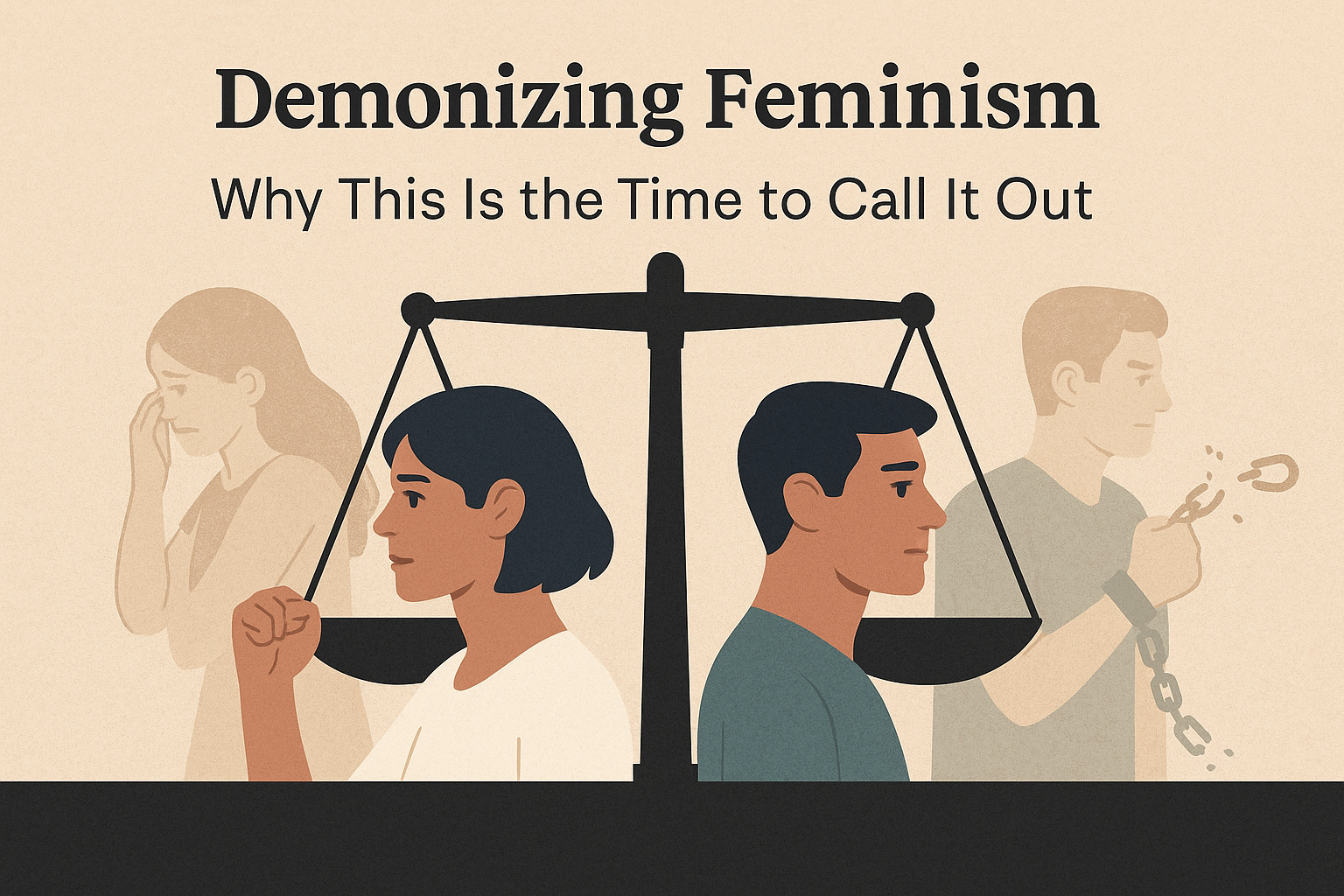
In the past few months, social media has been flooded with conversations about feminism, gender dynamics, and the tension between misogyny and misandry. A recent viral video reignited that debate, and I’ve been thinking deeply about something many people asked:
What do we call “extreme” for a group that has been oppressed for generations?
And is misandry simply a reaction to misogyny?
The more I reflect on it, the clearer one thing becomes:
Oppression distorts the scale.
What looks “extreme” to the privileged often looks like survival to the oppressed.
1.Why women’s anger is often mislabelled as extremism
It is impossible to talk about women’s reactions without acknowledging the world they’re reacting to:
- Widows in parts of Africa still shaved and humiliated to “prove” innocence
- Girls blamed for their abuse
- Cultures that demand women endure in silence
- Religious spaces that emphasise “submission” but rarely define healthy leadership
- Legal systems that fail to protect women
- Economic structures that keep women financially dependent
- Generational trauma passed from mother to daughter
This is what scholars call everyday patriarchy; the small, constant, socially accepted pressures that shape women’s lives.
In a world like this, anger is not random. It is not “madness.” It is the inevitable response to centuries of silencing.
When someone has been denied safety, dignity, autonomy and voice, their expression of pain may not always be neat, structured or gentle. But it is never baseless.
2. Misogyny is systemic. Misandry is reactive. They are not equal.
Misogyny is not simply dislike. It is a global structure that shapes: laws, religious doctrine, cultural norms, workplace practices, access to education, healthcare outcomes, political representation.
Misandry, on the other hand, is mostly emotional and has no institutional power behind it.
A woman saying “men are dangerous” online cannot stop a man from getting: a job, a mortgage, legal protection, political office, bodily autonomy.
Misogyny kills. Misandry rarely can, because it operates without structural backing. But that doesn’t mean misandry should be glorified. It harms trust, dialogue and healthy gender relationships.
Still, equating the two is a false balance.
3. “But aren’t some feminists extreme?”
This is where nuance is needed.
Radical feminism, historically, has been labelled “extreme” not because it was violent, but because it challenged patriarchal structures head-on.
It pushed for: marital rape laws, domestic violence recognition, reproductive rights, workplace equality, safety legislation. Many of the rights women enjoy today were once considered “too radical.”
So when people ask, “What is extreme?”, the question becomes: Is the idea actually extreme, or does it simply challenge a system that has benefited men for centuries?
4. The real danger: How patriarchy weaponises extreme examples
Whenever a woman expresses rage, whether justified or exaggerated, patriarchy is quick to amplify that clip and say: “See? Feminism has gone too far.” “Women hate men.” “This is why we don’t listen to them.” It is a very common tactic in social movements: magnify the loudest 1%, use it to discredit the valid 99%, shift attention away from real structural problems. We have seen this with civil rights, LGBTQ+ rights, and anti-colonial struggles.
The oppressor is always more offended by the resistance than by the harm that caused it.
5. So what actually is “extreme”?
If we’re being honest, there is only one true extreme in this conversation: Calls for violence, rape, killing, or harm. Not because they’re equal to centuries of misogyny, but because violence itself is unacceptable in any liberation movement. Most women who express misandry are not asking for policies that harm men. They are venting from trauma, humour, frustration or emotional overload. This is why balancing empathy with accountability is crucial.
6. The painful question: What do oppressed people owe the system?
Do they owe politeness? Gentleness? Tone? Perfect emotional regulation? Women have been told to “be quiet,” “be calm,” “be patient,” “be respectful” for generations. If their voices finally shake the table, is that truly “extreme”?
Or is it simply the sound of a group that has stopped whispering?
7. Where I land in this conversation
- Misogyny is the system.
- Misandry is the reaction.
- Neither should be violent.
- But only one has shaped global history through laws, religion and institutions.
- Feminism’s goal is not to punish men, but to dismantle systems that harm everyone, men included.
Some reactions online may be exaggerated, but they are symptoms, not the root cause. If we keep attacking the reaction and ignoring the system, nothing will change.
The deeper question we must keep asking is; How do we build a world where women don’t have to scream to be heard and men don’t interpret accountability as attack?
That is the real work ahead.